Learning and Transfer activity

nicklucking3's avatarNicholas Lucking Niehus

Step 1: Making the learner understand what you are trying to teach, and make it personal for them so that they are my engaged into the learning. You have to know the audience you are teaching. (Intro 10 min)

Step 2: Memorization activities and a little lecture notes to understand the topic presented. (Notes 15 min)

Step 3: Apply the notes to a fill in the blank worksheet activity and let them try it and figure it out. After, review the questions and answers to make sure the class is familiar with them. (Review 20 min)

Step 4: Wrap it, and looking forward to the upcoming classes and looking at the course schedule to get familiar with the due dates. (Wrap-up 5 min)
View original post

English 1001 To-Do list

To-Do list:

MA #1

finish writing, and add more concepts and thoughts to it.

make a cited page

MA#2

Finish adding in my sources to the different resources I used

MA#3

Finish my writing, and 3 different genre , and last activity

MA#4

The portfolio

clean up the site, mark everything on the cite, make it look pretty.

upload the posts that I haven’t uploaded

Peer reviews

Discussion of Transfer and Learning

nicklucking3's avatarNicholas Lucking Niehus

The passage that we strongly agree with is “Novices and Experts” and it states that, “We turn now to the question of how experts’ knowledge is organized and how this affects their abilities to understand and represent problems. Their knowledge is not simply a list of facts and formulas that are relevant to their domain; instead, their knowledge is organized around core concepts or“big ideas” that guide their thinking about their domains”. We said we agree with this because this is how the experts stay experts, they organize their knowledge into categories and use their knowledge for different fields of study.

The passage that we don’t agree with is in Bergmann and Zepernick and that states that, “The results of our study suggest that students approach learning to write with a number of preconceptions that strongly influence how much they are able to learn and also with strong, if intuitive, rhetorical skills…

View original post 61 more words

Learning and Transfer 3-Minute Reflection

There are a lot of ways someone can be an expert in different things. I am an expert in different things it takes time and effort to become an expert, learning the skill over time will help you become an expert. We can’t learn everything or be an expert in all the things, we can be novice in somethings, because we might not have interest in learning it, or we are unable to understand the information and can’t be an expert. Which sometimes can lead you to being somewhere in between being an expert and a novice,

Bergmann & Zepenick Transfer Passage

“How Students Talked about Actually Learning to Write” on page 135 my peers passages: 129 number 3, 136-137. This passage helps me to talk about how we go about learning to write, the different ways students do it. I have done a lot of work in this class and this will help me reflect on what was learned. I will be using it to show how i learned and show how my writing progressed. I will be using my Major Assignments to show the different areas I am good at writing in. I will be using this passage to give examples and quotes in my paper.

New Key: In-Class 3-Minute Reflection

Yancey wrote about what she wanted to say in different styles of writing, she stated with a speech type of writing and moved on to write as an article. sometimes moves like that helps it grab more audience to read the writing and get into different genres, it’s a big point that it reaches as many readers as it can from different genres and topics.

5) Reflection

Here’s the site I used: Site

Yancey define reflection as “the dialectical process by which we develop and achieve, first, specific goals for learning; second, strategies for reaching those goals; and third, means of determining whether or not we have met those goals or other goals.” While the site found defined as “a form of personal response to experiences, situations, events or new information, and a ‘processing’ phase where thinking and learning take place.” Yancey cited other authors that was used to help him give the definition of reflection.

Reflection enable writers to have a very meaningful work of writing, it helps them go beyond with the text. Understanding audience, genre, and rhetorical situations and how they connect together helps to reflect better on how to write. The site and the Yancey have very similar sayings and bring to the same important points.

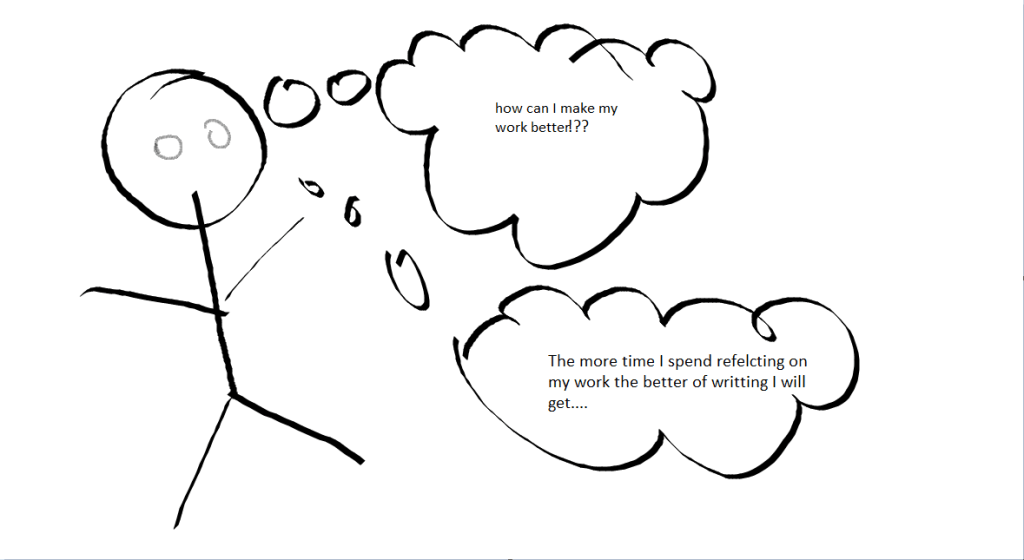
Take more time to think about work to get a good writing.

7) Knowledge

Knowledge to me is defined as the information we learn from experiences, that we can be learned by someone with that knowledge or can be found and discovered to be taught. The meaning can differ from person to the other, people might define it as the information a person learns without looking at the aspect of having to discover the knowledge to be able to teach it. There could be a physics law that no have yet discovered and that’s the knowledge that we are waiting to discover.

Collaboration in the knowledge-making process is an important aspect of it because without working with others with the same experience and higher it would take a person a long time to find. You have a group you could get feedback from, discuss things together. They might think of something you might have never looked at like that and lead to an answer. Johnson’s discussion had a lot of good points in it, explaining the process of knowledge-making changed the way I looked at knowledge. This can be used to have a better research process, it will help get to more knowledge.

Design a site like this with WordPress.com
Get started